

Did you want to take a loan but you’re not sure if you are qualified or not and you want to quickly check your loan eligibility? Applying for a loan blindly may hurt your credit score and can cause serious financial burden to you; that’s where a loan eligibility checker comes in. A loan eligibility checker tells you the amount you can qualify for and where you stand before you even apply.
Loan Eligibility Checker
Find out how much you can qualify for in seconds
Your Estimated Eligibility
What Is a Loan Eligibility Checker?
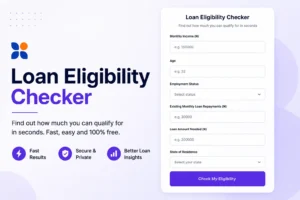
Loan eligibility checker is a simple online tool that allows you to enter a few details about yourself and then the tool will check if you are qualify for a loan or not.
This tool is designed to answer questions like “Can this person borrow?” It takes just few seconds for this to evaluate your loan eligibility and the tool is completely free, so it costs you nothing to use it.
Think of the eligibility checker as a filter that you run your details through to know whether you will be eligible to take a loan even before approaching any lender.
This tool uses your personal information to assess whether you can apply for different loans and if you know you want to borrow money but aren’t sure about your financial situation the tool simplifies the entire application process by helping you find out the loan amount you might receive.
The best part is that, this tool does not affect your credit score. It is a soft eligibility checker and not a loan application and you can check as many times as you want.
How to Use the Loan Eligibility Checker
The loan app eligibility checker tool has six information fields. You are to fill each field correctly and then click the button to run the check. Below are the exact steps to use it:
1. Enter Your Monthly Income
The first field says “Monthly Income (₦).” In this field, you are to type in your monthly take-home income. Use your actual income, not your gross salary.
2. Enter Your Age
The second field ask for your “Age.” Type in your current age. Most lenders accept ages between 18 to 59. Outside that range, you may not be eligible.
3. Select Your Employment Status
The third field is a dropdown. It says “Select status.” Click it to open the options and choose the one that matches your status. The available options include: salaried, self-employed, and business owner. Pick one and move on to the next step.
4. Enter Existing Loan Repayments
If you are owing a loan somewhere else, then you need to fill this field that says “Existing Monthly Loan Repayments (₦).” Type in the amount you are owing across all current loans. If you have none, type 0.
5. Enter Your Loan Amount Needed
The fifth field says “Loan Amount Needed (₦).” Enter the exact amount you want to borrow. Be specific with the amount you want. Don’t just enter a random number.
6. Select Your State of Residence
The last field is another dropdown. It says “Select your state.” Click it and choose your state of origin.
7. Check Your Eligibility
Click the “Check My Eligibility” button and the tool will process your details instantly and your eligibility result will appear on the screen.
How Lenders Determine Loan Eligibility in Nigeria
Lenders don’t just take your word for it. They check several things about you, like your monthly income, credit history, job stability, and existing debts. They also check your repayment history.
Your loan eligibility score is a number. It represents your creditworthiness. It factors in income, employment, and debt. In Nigeria, credit scores range from 300 to 900. Higher scores mean better creditworthiness. Lenders use this to judge your risk level.
Lenders also use a simple formula. They take 40 to 50 percent of your monthly income. Then they deduct your existing loan repayments. What’s left determines your borrowing capacity. So the more debt you carry, the less you can borrow.
Factors Affecting Loan Approval in Nigeria
When it comes to loan eligibility check, the lenders usually take many factors into account. So this is to tell you that several things affect your loan approval and knowing these things that I’ll help you prepare better.
Some of the key factors affecting loan approval in Nigeria include:
1. Your Monthly Income
Lenders assume that the higher your income, the higher your borrowing power. So higher income means you can borrow more. Lenders use your income to evaluate your ability to repay the loan.
For salaried workers, they know that you have a stable income. For self-employed people, you have to keep a consistent higher income records to be considered.
A predictable income structure helps in improving your chances of getting access to higher loans.
2. Your Credit History
This is the biggest factor that lenders use to check your eligibility for loan. Your credit score and history have the biggest impact on your loan eligibility.
In case you are wondering what credit history is, let me explain: your credit history is financial record that shows your borrowed and repaid loans over time.
It shows the following:
- Loans and credit you’ve borrowed over time
- Payment behaviour which shows whether you have been repaying these loans at the actual time of whether you have been defaulting
- How much loan you are owing at the moment and those you are owing.
Lenders access these information and use it to decide whether they can trust you with their money or not.
A good history will give you access to higher loan amount, lower interest rates and faster loan approval while bad history will mostly result in loan application rejection or high interest.
So your credit history will directly affect your loan eligibility, interest rate, loan tenure, and amount. Failure to repay a loan will hurt your score badly while repaying on time will build it up.
3. Your Existing Loan Repayments
This is part of your credit history. Having too many active loans is a red flag. Each active loan lowers your credit limit irrespective of whether the loan is overdue or not.
Most lenders assume that having existing active loans reduce your available repayment capacity and as such, some of them won’t give you a loan if you have active loans on other platforms irrespective of whether the loan is overdue or not.
Note: having an active loan that is not overdue is not a bad credit history on its own, but it impacts the available loan limit pegged for your profile and it’s sometimes perceived as a red flag to some lenders.
4. Your Age
Lenders are not permitted to give loans to underage and teenagers or elderly people who have lesser financial inflows.
To access most loans in Nigeria, you must be between 18 and 59 years old. Being too young or being too old will always limit your eligibility. Most lenders in Nigeria are very strict about this.
5. Your Employment Status
Most lenders in Nigeria are interested in knowing your employment status. In fact, they are some lenders that only give loans to salaried workers.
Salaried workers are seen as people with lower risk since they have a stable monthly income while self-employed applicants need stronger bank statement to prove their financial capacity.
6. Your State of Residence
They are some lenders in Nigeria that don’t operate in every state. For such lenders , your state of origin or residence may affects your eligibility.
7. Multiple Applications at Once
Each loan application leaves a trace to your loan profile which can be accessed by other lenders. Too many applications or rejections will damage your credit rating.
You don’t have to apply everywhere at the same time. Choose few lenders and stick to them. That’s why it’s advisable to use the eligibility checker first to check your chances and this will help you to apply only where you’re likely to get approval.
FAQs About Loan Eligibility
How do I check if I am eligible for a loan?
You can use our free “Loan Eligibility Checker” tools to check your loan eligibility for free. All you need is to provide basic information and the tool will give your estimated loan eligibility score.
How can I improve my loan eligibility fast?
To improve your loan eligibility score, pay off old loans on time for 90 days and ensure you reduce your debt completely.
Does checking loan eligibility affect my credit score?
No. Checking your loan eligibility does not affect your credit score. Such checks are soft inquiries which do not affect credit score.
What can disqualify me from getting a loan?
- Bad credit history
- Low credit score
- Late loan repayments
- Low income
- Age younger than 18 or older than 59
- No BVN
- Having existing active loans
- No NIN
- Too many loan rejections
Conclusion
It’s high time you stop guessing before you applying for a loan because each loan rejection you get destroys your credit profile.
Instead, use the loan eligibility checker first to check your chances and this will help you to apply only where you’re likely to get approval. The check is fast and it’s completely free.
